
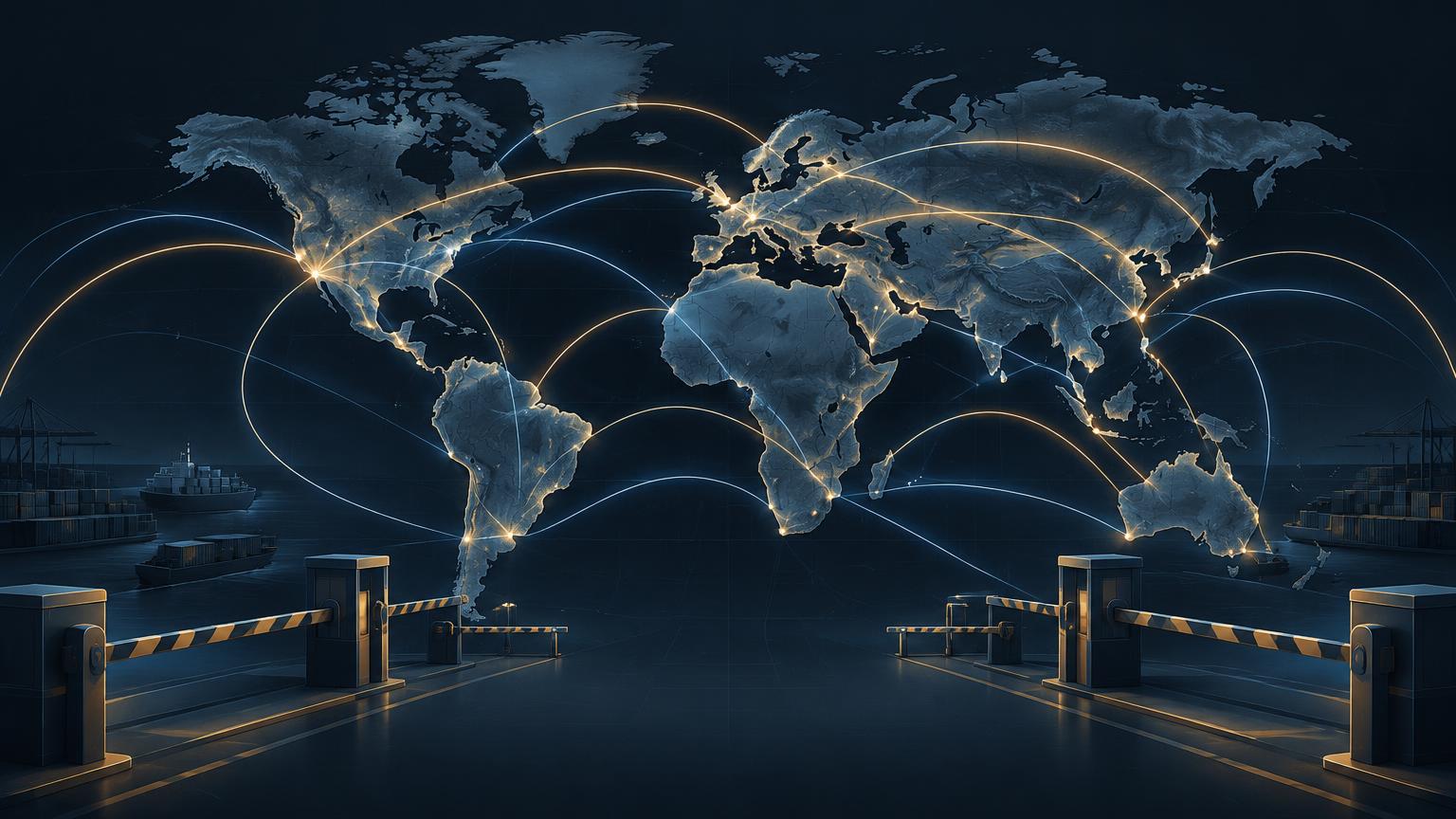
EU and 33 partner countries issue no-fees, no-tolls pledge for international straits
Event summary
On October 12 the EU and 33 non-EU countries publicly backed a pledge opposing unlawful tolls, discriminatory restrictions and prior authorization for passage through international straits. The declaration coordinates diplomatic positions but does not reopen shipping routes, remove existing charges or create a new enforcement mechanism.
CHRONOS Wire · October 12 · Alert 20
Publication details
- Published
- Updated
- Revision
- r497730
Cliff Notes
- On October 12, 27 EU member states and 33 partner countries backed an international-straits no-fees/no-tolls pledge.
- The pledge opposes unlawful tolls, discriminatory passage restrictions and prior authorization requirements.
- It supports defensive, non-escalatory multilateral maritime cooperation under international law.
- It is a diplomatic statement, not evidence of restored passage, lower freight rates or enforceable new sanctions.
U.S. Impact
Current impact
Low
The pledge creates an international diplomatic signal with potential indirect relevance to U.S. shipping and energy interests, but no attributable U.S. operating or price effect has been measured.
Potential impact
Low
If governments translate the pledge into safer, less restricted passage, U.S. importers, energy markets and logistics operators could experience indirect benefits; implementation is uncertain.
- Impact type
- Indirect
- Time horizon
- Short to medium term; conditional on follow-through
- Confidence
- High
- Key channels
- International maritime trade · Oil and LNG transport · Marine insurance · Shipping logistics
Direct effects
Low
No direct U.S. legal or operational action is established by the pledge.
Indirect effects
Low
Potential future shipping and energy-market transmission if diplomatic commitments affect navigation conditions.
- Maritime access and insurance
- Energy transport costs
- Global freight and supply chains
Supporting evidence
- EEAS lists 27 EU member states and 33 other countries as endorsers.
- Canada independently publishes the October 12 pledge.
- The pledge explicitly covers maritime restrictions with potential international trade and energy consequences.
Negative evidence
- No verified U.S. policy change or direct U.S. effect.
- No new passage reopening or maritime enforcement mechanism.
- No attributable market repricing established.
Uncertainties
- Actual government follow-through
- Magnitude and timing of shipping response
- U.S. company exposure and market attribution
Assessment reasoning
The U.S. is not listed as an endorser of this pledge. The new action is diplomatic and creates no observed direct U.S. transaction, production or price change. Nonzero scores reflect independently judged indirect policy and trade exposure, not verified realized effects. Actual U.S. economic transmission depends on whether transit restrictions and risks change.
U.S. Impact is an analytical assessment of the estimated current and potential effects on the United States. It is not a probability forecast.
The European External Action Service published a maritime-law pledge on October 12, 2026, announced by EU foreign policy chief Kaja Kallas and supported by all 27 EU member states plus 33 other countries. The text calls for multilateral cooperation, defensive and non-escalatory freedom-of-navigation initiatives, rejection of coercive unilateral restrictions, and opposition to unlawful tolls or prior-authorization requirements for ships exercising lawful transit rights through international straits. Canada published the same declaration independently. The pledge is a new formal alignment of 60 governments, not proof that any blocked or restricted passage has been restored. Similar navigation principles and a September 24 multinational statement predate this pledge; its distinctive new fact is this October 12 EU-led no-fees/no-tolls commitment with a published signatory list.
ELI5: Plain-English Explanation
Sixty governments agreed that ships using international straits should not face unlawful tolls or discriminatory permission rules. Agreeing on the rule does not mean a blocked waterway has reopened or that ships are safer today.
Why This Is Urgent
International strait restrictions affect energy, cargo routing and supply-chain risk. The newly published 60-government position may shape negotiations and maritime-security coordination, but immediate operating consequences remain unconfirmed.
What Changed
On October 12 the European External Action Service publicly announced a specifically titled No Fees/No Tolls pledge endorsed by all 27 EU states and 33 non-EU countries; Canada separately published the text.
What Is Genuinely New
The formally announced October 12 EU-led pledge, its explicit no-fees/no-tolls language, and its enumerated 60-government support. The underlying legal principles and earlier multilateral condemnations are not new.
CHRONOS Bottom Line
A broad coalition formalized opposition to unlawful strait tolls and restrictions. This strengthens diplomatic signaling but does not itself change access, enforcement, shipping volumes or costs.
Direct Effects
- A published joint diplomatic commitment by 60 governments opposing unlawful fees and restrictions in international straits.
- A formal reference point for government-to-government maritime-law and shipping-security discussions.
Indirect / Second-Order Effects
- Potential influence on future multilateral maritime negotiations and shipping-company risk expectations.
- Possible longer-term implications for energy trade, cargo insurance, route planning and supply-chain reliability if follow-through occurs.
Market Reality Gap
No measured decline in freight rates, insurance premiums or oil prices was causally linked to the pledge; the text contains no binding mechanism to compel reopening of a strait.
Negative Evidence / Invalidation
- The pledge does not announce a reopened waterway or new operational escort deployment.
- Existing IMO statements and a September 24 multinational declaration already defended navigation rights.
- No independent evidence of changed ship transits, charges, oil flows or freight pricing.
- The United States is not named among the 33 non-EU endorsing countries in the EEAS list.
Resilience / Shock Absorbers
- Existing IMO maritime rules and UNCLOS principles provide established legal reference points.
- Alternative routes, inventories and shipping adaptations may buffer immediate effects of disruptions.
- Non-escalatory multilateral coordination could provide channels for follow-through.
Confirmation Signals
- Official maritime authority measures implementing the pledge or additional governments joining.
- Documented removal of tolls or discriminatory passage conditions.
- Verified improvement in commercial vessel passage and maritime safety.
Invalidation Signals
- Signatory governments clarify that the text is non-operational with no follow-through.
- Relevant coastal authorities continue imposing the same restrictions without modification.
Watch Windows
- 0–6h: official clarifications, government statements and response by affected coastal states.
- 6–24h: IMO and shipping-industry reactions; any concrete enforcement or coordination measures.
- 24–72h: verifiable vessel transit, insurance and freight-market changes.
Uncertainties / Known Unknowns
- Whether any coastal authority changes its behavior in response to the pledge.
- Whether the coalition plans specific operational follow-through.
- Whether shipping markets price in any durable change.
- Whether additional states, including the United States, later endorse the pledge.
Detailed Analysis
The EEAS text invokes the United Nations Convention on the Law of the Sea and customary international law, calls for support of maritime institutions including the IMO, and rejects coercive unilateral measures affecting lawful transit through international straits. EEAS lists all EU members and 33 partners including Australia, Bahrain, Canada, Japan, Oman, Singapore, South Korea, Switzerland and the United Kingdom. Reuters reported the 60-country pledge at 15:51 UTC October 12. The event time is the October 12 public announcement; its Reuters publication time is a separate evidence timestamp. Earlier IMO and September multinational statements already affirmed navigation rights, so the novelty is a fresh named pledge and signatory coalition, not a newly invented legal right. No operational timetable, maritime escort deployment, binding sanction, shipping resumption, oil-volume recovery, freight repricing or demonstrated compliance by governments imposing restrictions is established. The U.S. is not listed among the 33 non-EU signatories, and no U.S. policy change is inferred. Risks include continued unilateral restrictions despite the declaration and difficulty converting consensus into practical safe passage.
Affected Countries
- European Union
- Australia
- Bahrain
- Canada
- Japan
- Oman
- Singapore
- South Korea
- United Kingdom
- Switzerland
- Yemen
Affected Industries
- Maritime shipping
- Energy transport
- Cargo insurance
- International trade
- Port logistics
Affected Assets
- International navigation straits
- Commercial shipping routes
- Marine insurance exposure
- Oil and LNG maritime trade
Sources / Evidence
- 01
- 02
- 03
- 04
Follow CHRONOS ALERTS
Published alerts also appear on Instagram and Threads as @chronosalerts.